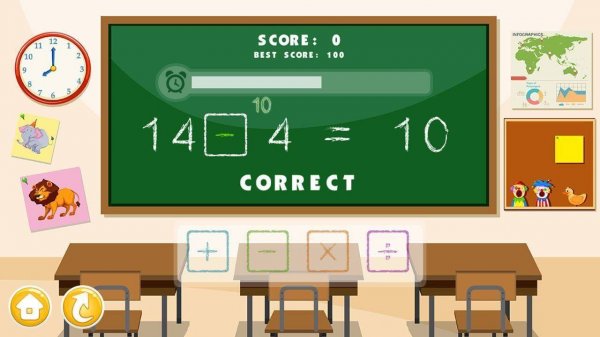
Core Gameplay Loop
Each round presents an equation with a missing operator, such as 8 ? 4 = 2. Four buttons below offer the possible operations. The player taps the correct one to advance. A running clock encourages fast decisions, and the goal is to answer as many equations as possible before time expires. Correct answers add to the score; incorrect ones do not deduct points, keeping the experience low-pressure.
Visual Design & Accessibility
The interface uses bright, high-contrast colors and large buttons, making it easy to read and tap on any device. No complicated menus or tutorials are required. Players of all ages, from young learners to adults, can start playing immediately. The design focuses on clarity, ensuring that the equation and options are always front and center.
Progression & Difficulty Curve
Early rounds feature simple equations, often with small numbers and straightforward operations. As the player accumulates correct answers, the game introduces larger numbers and less obvious operator choices. This gradual increase in difficulty helps build confidence while still providing a challenge for experienced players. The timer remains constant, so speed becomes more critical as the math gets harder.
Replay Value & Goal Setting
The game tracks the highest score achieved in a session, giving players a personal target to beat. This simple leaderboard encourages repeated play, as each attempt offers a chance to improve. Short round lengths mean players can fit in a few tries during a break or commute, making it easy to practice regularly and see progress over time.
Educational Benefits
Regular play reinforces the relationship between numbers and operations, strengthening mental arithmetic. The need to quickly choose between addition, subtraction, multiplication, and division sharpens decision-making skills. Because the game is self-contained and free from distracting content, it works well in classroom settings or as a focused home activity for children and adults alike.








Comments
0 comments